How to Buy Kids T-Shirts Online and Get the Right Fit the First Time
Learn how to buy kids T-shirts online with the right size, fit, fabric, and style using practical measurement and shopping tips.
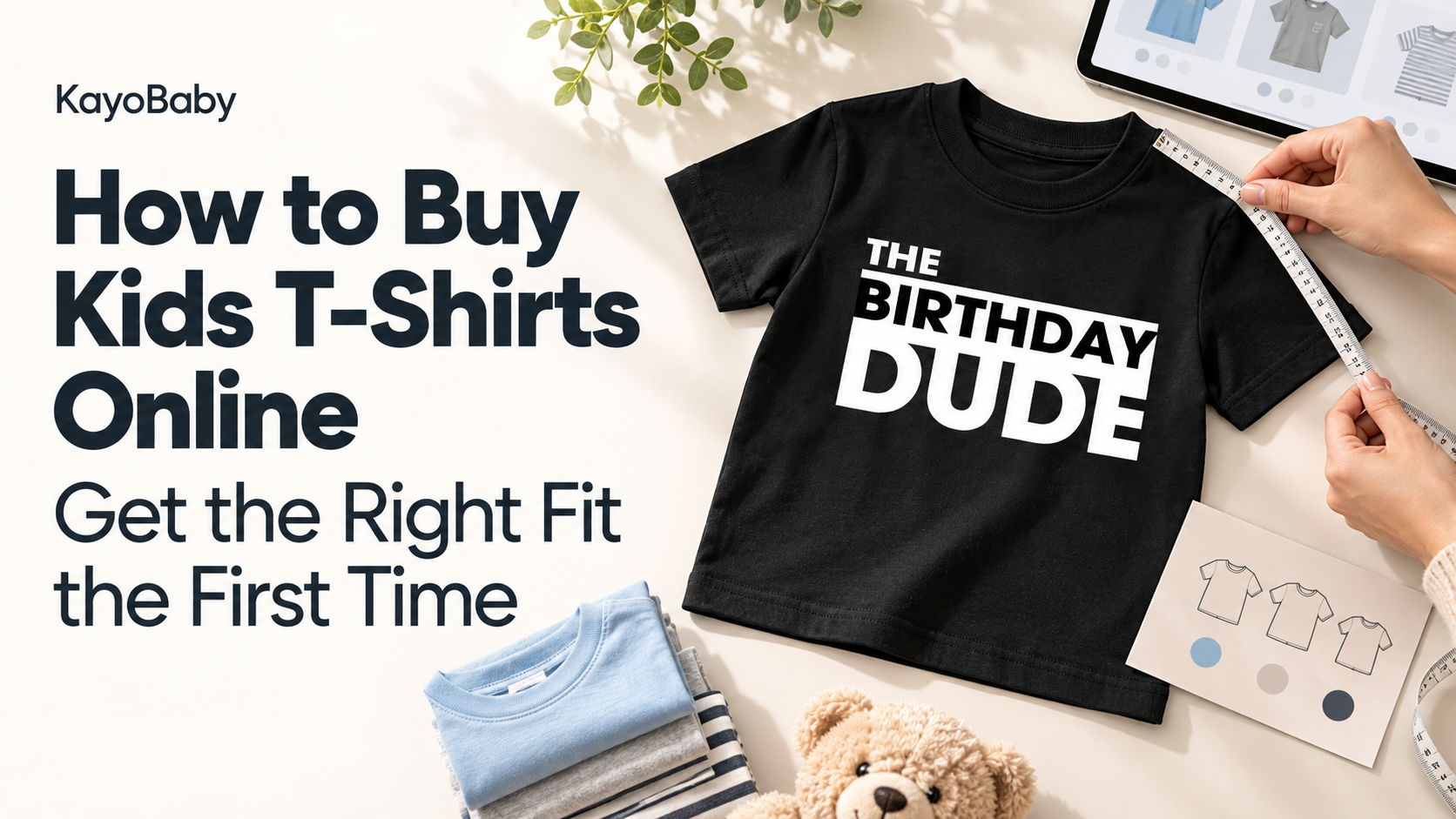
Buying kids t shirts online can save time and give parents access to far more designs than a physical store. However, one common concern remains: Will the T-shirt actually fit my child?
Children grow quickly, and clothing sizes can vary between brands. A T-shirt labelled as 5–6 years from one store may fit differently from the same age category at another. Relying only on your child's age is therefore not always enough.
The better approach is to compare your child's actual measurements with the seller's size chart, understand the desired fit, check the fabric and construction, and consider how the T-shirt will be used.
Whether you are looking for everyday T-shirts, graphic designs, matching family outfits, or comfortable clothing for outdoor activities, the following guide can help you buy kids T-shirts online with greater confidence.
Why Buying the Right Size Matters
The correct size is about more than appearance. A T-shirt that is too tight can restrict movement, while an oversized one may feel uncomfortable or look untidy.
A well-fitting kids T-shirt should provide enough room for:
- Comfortable arm movement
- Normal chest and shoulder movement
- Easy dressing and undressing
- Comfortable sitting, playing, and running
- Some growing room without looking excessively loose
For everyday clothing, a slightly relaxed fit can be practical because children need freedom to move. For a special occasion or coordinated family outfit, parents may prefer a more structured fit.
The important point is to choose based on measurements and intended use rather than the age label alone.
Step 1: Measure Your Child Before Ordering
The most reliable starting point is taking your child's measurements at home.
You generally need to check the chest, shoulder, T-shirt length, and sometimes sleeve length, depending on the seller's size chart.
How to Measure Chest Size
Wrap a soft measuring tape around the fullest part of your child's chest. Keep the tape comfortably level without pulling it tightly.
Record the measurement in inches or centimetres, depending on the size chart.
How to Measure T-Shirt Length
Measure from the highest point of the shoulder down to where you want the T-shirt to finish.
This measurement is particularly useful when your child is tall or has a longer torso. Two children of the same age can have noticeably different body proportions.
How to Measure Shoulder Width
Measure across the back from one shoulder point to the other. This can help you determine whether a T-shirt will sit naturally on the shoulders rather than pulling or hanging excessively.
Step 2: Use the Brand's Size Chart
Never assume that a universal kids' clothing size exists.
A useful size chart may include age ranges, chest measurements, length, and other garment dimensions. Compare your child's measurements directly with those listed by the brand.
For example, if your child is six years old but has a chest measurement closer to the next size category, choosing solely based on "6 years" could result in a tighter fit.
When shopping for kids' T-shirts online, always ask:
- Does the size chart show garment measurements or body measurements?
- Are measurements provided in inches or centimetres?
- Does the chart separate boys' and girls' sizes?
- Is the T-shirt designed with a regular, relaxed, or oversized fit?
- What should you do if your child falls between two sizes?
If a child is between sizes, consider the garment's intended use. For a growing child, choosing the larger size can sometimes provide more useful wear, provided the extra length and width are still comfortable.
Step 3: Understand the Difference Between Age and Size
Age-based sizing is convenient, but children do not grow according to identical size patterns.
A 7-year-old child may be shorter and slimmer than another 7-year-old, while a younger child may have a larger chest or longer torso.
This is why "4–5 years," "6–7 years," or similar labels should be treated as a starting point rather than a guarantee.
For online shopping, think of sizing this way:
Age = reference point
Measurements = decision-making tool
This simple change can significantly reduce the chance of ordering the wrong size.
Step 4: Choose the Right Fabric for the Intended Use
Fabric has a direct effect on how comfortable a T-shirt feels during everyday wear.
For children's clothing, parents often look for materials that feel soft, allow comfortable movement, and are practical to maintain.
Cotton T-Shirts
Cotton is a popular choice for children's everyday clothing because of its familiar soft feel and versatility.
Cotton kids T-shirts can work well for:
- School-related casual wear where permitted
- Home use
- Weekend outings
- Playtime
- Everyday family activities
Blended Fabrics
Some T-shirts use cotton blended with other fibres. These fabrics can offer different characteristics, such as stretch, shape retention, or easier maintenance.
Instead of choosing based only on the fibre name, consider the complete product description, fabric composition, construction, and intended use.
Step 5: Check the T-Shirt Construction
Two T-shirts can look similar in product photographs but differ considerably in construction.
Before purchasing, check the product information for details such as:
- Neck construction
- Sleeve style
- Stitching
- Fabric composition
- Print or graphic application
- Care instructions
- Overall fit
- Available sizes
For younger children, a comfortable neckline can make dressing easier. For active children, construction and fabric flexibility become particularly important.
Parents should also look at customer reviews where available. Comments about actual sizing, fabric feel, wash performance, and fit can provide useful information that product photographs cannot.
Step 6: Decide Between Regular, Relaxed, and Oversized Fits
The same size can look very different depending on the cut.
Regular Fit
A regular-fit T-shirt follows the body's general shape without being excessively tight or loose.
Best for: everyday outfits and a neat appearance.
Relaxed Fit
A relaxed T-shirt provides additional room around the body.
Best for: active children, casual outfits, and parents who prefer a little extra room.
Oversized Fit
Oversized T-shirts are intentionally wider and longer.
Best for: fashion-focused casual outfits and specific styling preferences.
Do not automatically order a larger standard size when you want an oversized appearance. A larger size may increase the length and shoulder width in ways that were not intended. If a brand offers an actual oversized design, its proportions are usually more appropriate.
Step 7: Consider Your Child's Growing Room
Children can outgrow clothes surprisingly quickly. That makes growing room an important buying consideration.
However, buying substantially oversized clothing just because your child is growing is not always economical. If a T-shirt is uncomfortable now, it may spend more time sitting in the wardrobe than being worn.
A practical approach is to choose a size that provides comfortable movement and modest growing room.
For frequently worn basics, buying a small number of correctly sized T-shirts can be more useful than purchasing many pieces that are several sizes too large.
Step 8: Check Product Photos Carefully
Online photographs are useful, but they should not be your only source of information.
Look at multiple images to understand:
- Front and back appearance
- Neckline
- Sleeve length
- Graphic placement
- Overall proportions
- How the T-shirt fits on the model
Also read the product description carefully.
A T-shirt may appear loose in a photograph because of the model's body proportions or styling. The actual garment measurements provide a much better basis for choosing your child's size.
Step 9: Think About Where Your Child Will Wear It
The best kids T-shirt depends partly on the occasion.
| Use Case | What to Prioritize |
|---|---|
| Everyday wear | Comfort, easy care, versatile design |
| Playtime | Comfortable fit and freedom of movement |
| Family outings | Design, fit, and coordination |
| Birthday parties | Graphic or themed designs |
| Family matching outfits | Consistent colours and available sizes |
| Hot weather | Lightweight, comfortable fabric |
| Gifts | Attractive design plus reliable sizing information |
This prevents a common mistake: choosing a T-shirt only because it looks attractive without considering whether it suits the child's normal routine.
Kids T-Shirts for Boys and Girls
Parents shopping online may search specifically for kids T-shirts for boys or kids T-shirts for girls, but the most important buying factors remain similar: size, comfort, fabric, construction, and design.
For younger children, playful graphics, characters, colours, and fun themes can make everyday clothing more appealing. Older children may have stronger preferences for specific designs, colours, sports themes, or casual styles.
At KayoBaby, parents can consider children's T-shirts as part of everyday wardrobes as well as coordinated family clothing, depending on the available designs and size options.
Common Mistakes to Avoid When Buying Kids T-Shirts Online
1. Choosing Only by Age
Age is not a precise measurement. Always compare your child's measurements with the brand's size chart.
2. Ignoring Garment Measurements
If the seller provides chest and length measurements, use them. They can be more useful than a generic S, M, or L label.
3. Buying Several Sizes Too Large
Extra growing room is useful, but excessive sizing can make a T-shirt uncomfortable and difficult to style.
4. Ignoring Fabric Details
A good-looking design does not automatically mean the fabric is suitable for your child's daily activities.
5. Not Checking the Return or Exchange Policy
Before placing an order, understand whether size exchanges are available, what conditions apply, and whether the product category has any restrictions.
6. Buying Only From the Product Image
Photos show appearance but cannot tell you everything about measurements, fabric composition, or actual fit.
7. Forgetting to Check the Care Instructions
Children's T-shirts often need regular washing. Before buying, check the recommended washing and drying instructions and consider whether they fit your routine.
How to Make Online Kids T-Shirt Shopping Easier
Create a simple measurement record for your child and update it periodically as they grow.
You can keep:
- Current chest measurement
- Current height
- Preferred T-shirt length
- Usually suitable size
- Favourite fit
- Preferred fabrics
- Recent purchases that fit well
When you find a T-shirt that fits particularly well, compare its measurements with future purchases. This creates a useful personal reference point and makes online shopping faster.
It is also worth reading recent customer reviews before purchasing. Look specifically for comments about whether the product runs small, large, or true to the listed measurements.
What Should You Check Before Clicking "Buy"?
Use this quick checklist before completing your order:
Size
- Have I measured my child's chest?
- Did I compare the measurement with the brand's chart?
- Is the desired fit regular, relaxed, or oversized?
Fabric
- Is the material suitable for the intended use?
- Does the product description clearly state the fabric composition?
Design
- Will my child actually enjoy wearing it?
- Is the design suitable for the occasion?
Practicality
- Are the care instructions manageable?
- Is the T-shirt appropriate for regular washing?
Purchase
- Have I checked the exchange or return conditions?
- Are the product details and size information clear?
Taking two or three minutes to check these points can prevent the inconvenience of receiving a T-shirt that does not fit properly.
Why KayoBaby Can Be Considered for Kids T-Shirts
When choosing kids t shirts, parents generally need a combination of practical sizing information, comfortable designs, and options suitable for different occasions.
KayoBaby offers children's clothing designed around everyday and family-oriented styles. For parents shopping online, the key is to review the available size information, product details, design, and care instructions before choosing a particular T-shirt.
Whether you are buying one T-shirt for everyday wear or putting together coordinated outfits for a family occasion, selecting the right size should remain the first priority.
Frequently Asked Questions
1. How do I choose the right size for kids T-shirts online?
Measure your child's chest and compare it with the seller's size chart. Also check T-shirt length and the intended fit. Do not rely only on age because children of the same age can have different body proportions.
2. Should I buy a bigger size for my growing child?
A small amount of growing room can be practical, especially for everyday clothing. However, avoid buying several sizes too large because the T-shirt may be uncomfortable or difficult to wear properly.
3. Are age-based kids T-shirt sizes accurate?
Age ranges are useful as general references but are not universally accurate. Brand sizing varies, so actual body or garment measurements should be used when available.
4. What fabric is best for kids T-shirts?
The right fabric depends on the child's use, weather, and personal comfort. Cotton is a common choice for everyday children's clothing, while blends may offer different characteristics. Always check the product's actual fabric composition.
5. How should a kids T-shirt fit?
A good fit should allow comfortable movement without excessive tightness around the chest, shoulders, or arms. The length should also be appropriate for the child's body proportions and the desired style.
6. What should I do if my child is between two sizes?
Compare both sizes using chest and length measurements. If your child needs growing room and the larger size still provides a comfortable fit, the larger option may be more practical. Check the seller's specific sizing guidance as well.
7. What should I check before buying kids T-shirts online?
Check the size chart, measurements, fabric composition, fit, product photographs, care instructions, reviews, and return or exchange policy before ordering.
8. How can I avoid ordering the wrong size?
Keep your child's latest measurements available and compare them directly with each brand's size chart. Avoid assuming that the same age or letter size will fit identically across different brands.
Conclusion
Buying kids t shirts online does not have to involve guesswork. The most reliable approach is to measure your child first, compare those measurements with the brand's size chart, understand the fit, check the fabric and construction, and consider how the T-shirt will actually be used.
For growing children, the goal is not simply to buy the largest available size. It is to find a comfortable fit that provides enough movement and useful wear without sacrificing comfort.
Before choosing a T-shirt from KayoBaby or any other online store, take a moment to check the measurements, product details, fabric, design, and exchange policy. A few careful checks before ordering can make online kids' clothing shopping considerably easier and help you choose T-shirts your child will actually enjoy wearing.